
In sheet metal work it is often possible to produce the same part by two different methods. Which one is right depends not on the part itself but on its geometry and the production quantity. This article compares the two methods and clarifies when each comes out ahead.
How Do the Two Methods Work?
Laser cutting is a contactless method. A focused laser beam melts the sheet and follows the desired contour. No die is needed; whatever the DXF file sent to the machine says is what gets cut.
Punch press uses tooling. The sheet, entering between a punch and a die, is pierced or formed to take the shape of the tool. To produce a given form, the corresponding die must first be available.
Geometry: Free Form or Repeating Form?
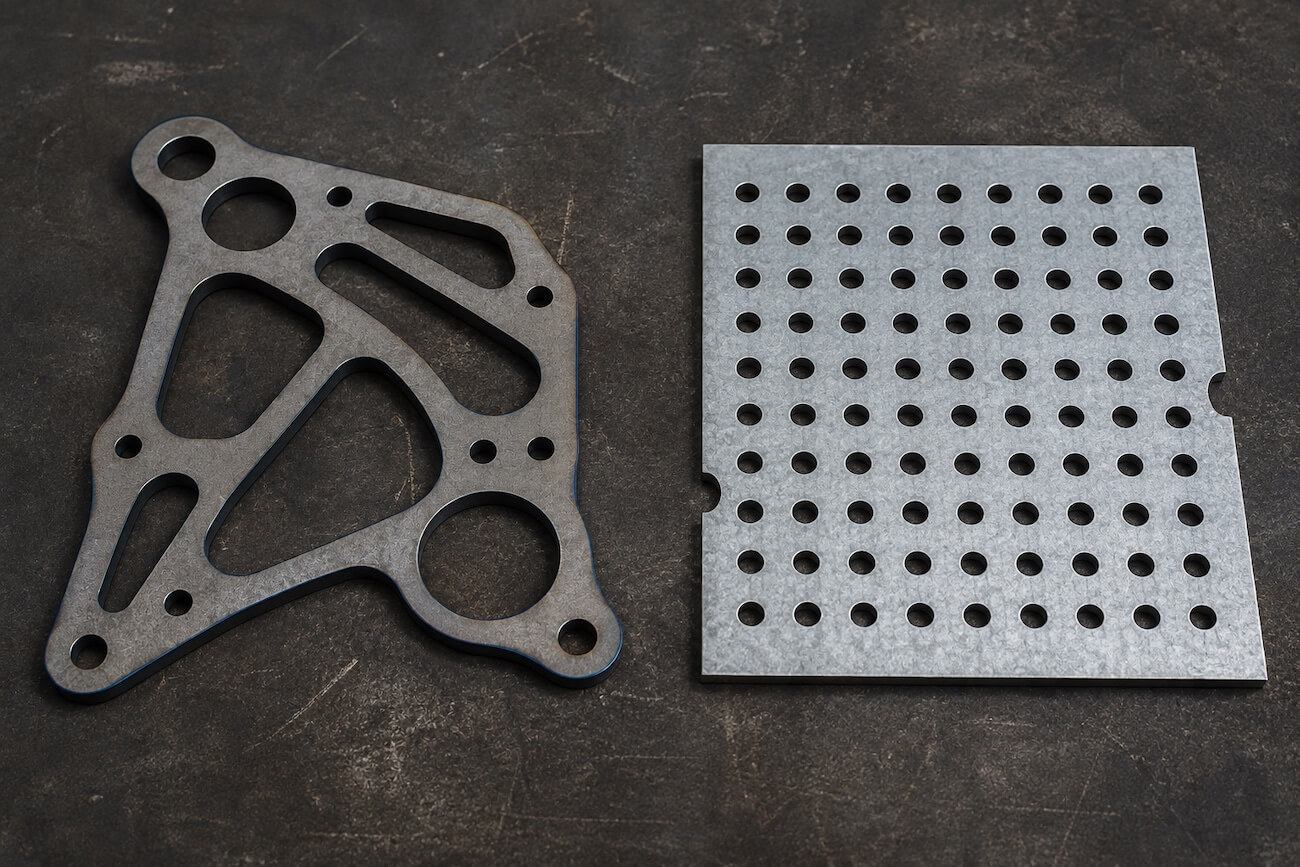
If your part contains organic curves, complex contours or holes each of a different size, laser cutting is the only sensible option. Producing these on a punch press would require a separate die for each.
If, on the other hand, your part consists of hundreds of repetitions of the same hole — a ventilation panel, a sieve plate, a panel back cover — the punch press is markedly faster. Where the laser pierces and cuts each hole one by one, the punch press completes a hole with every stroke.
Quantity: Across How Many Parts Is the Tooling Cost Divided?
The tooling cost of a punch press is fixed and is divided by the quantity produced. In low quantity work that cost pushes the unit price up; in high volume it becomes negligible and the punch press drops clearly below the laser.
Laser cutting has no tooling cost. Producing a single part is economical too; but the unit cost does not fall with quantity as quickly as it does on a punch press, because the machine spends the same time on every part.
The crossover point varies with material, hole count and whether the die already exists. This is why the decision is not made against a single threshold number; the drawing and the quantity are assessed together.
Forming: The Punch Press Capability the Laser Does Not Have
A punch press does not only pierce, it also forms: embossing, countersinking, louvres, stiffening channels and tapped-hole preparation are all done in a single stroke. Laser cutting can do none of these; such forms require either a punch press or a separate tooling operation.
In other words, if your part contains forms, the question is often not "which one" but "at which stage the punch press comes in".
Material and Thickness
Laser cutting is more comfortable than punch pressing in thick material; the thickness capacity of a punch press is limited by tonnage and tooling. In stainless steel and aluminium, the laser also gives a cleaner cut surface.
On the punch press side, high efficiency is achieved in thin and medium thickness sheet, particularly in galvanised and DKP.
How Is the Decision Made?
In practice most projects use both methods together: the outer contour is laser cut, while repeating holes and forms are made on the punch press. Three questions guide the decision:
1. Does the part contain repeating holes or forms?
2. How many will be produced?
3. What is the material type and thickness?
With these three pieces of information and your drawing in hand, we recommend the most economical method — rather than leaving the choice to you and producing expensively by the wrong route.
After Cutting
Whichever method is used, most parts are then bent and joined. After our laser cutting and punch press services, bending and welding are carried out in the same facility. See our sheet metal processing services page for the whole chain.