
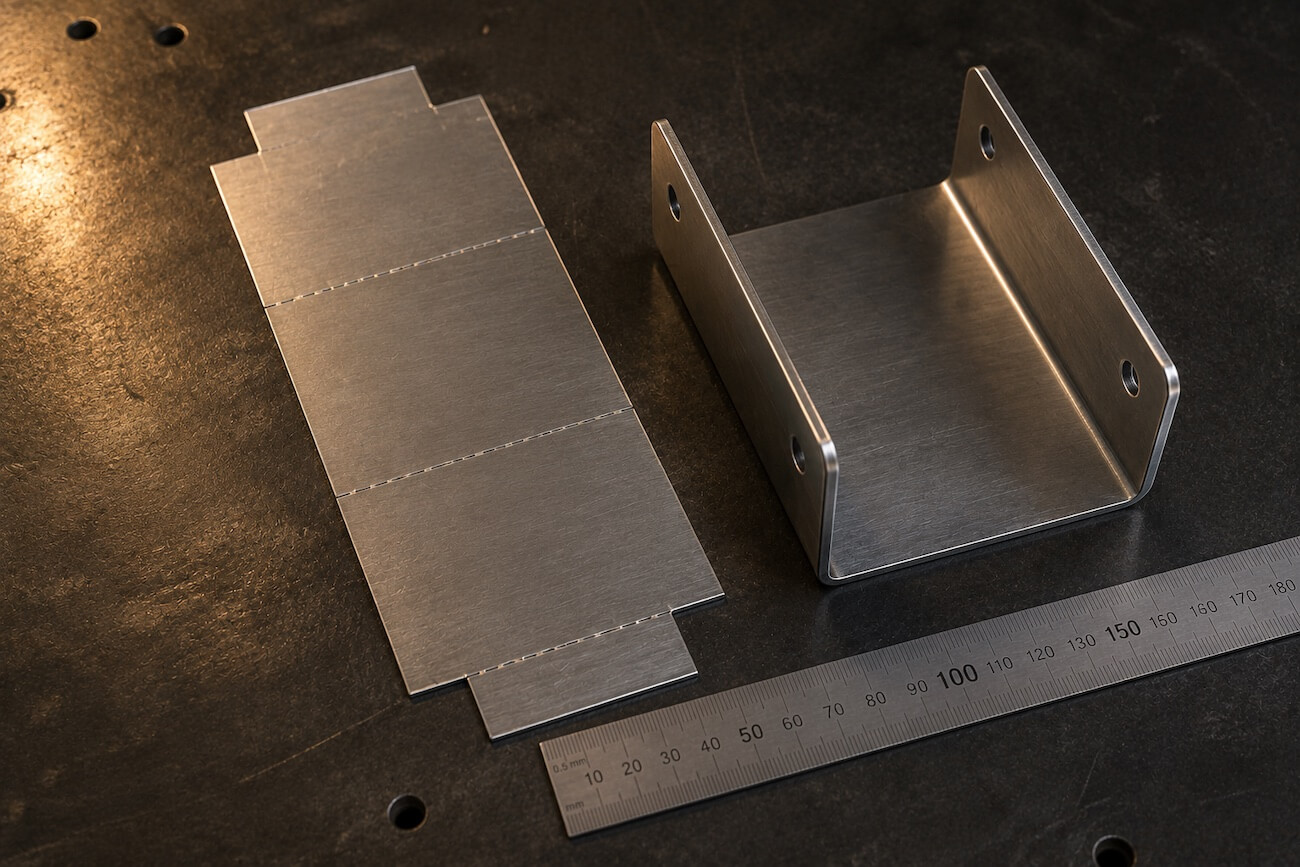
Press brake bending is the operation in which a flat sheet is bent under control on a press brake, between an upper punch and a lower die with a V opening. This is the step where parts such as boxes, profiles, brackets and panel bodies move from flat sheet into three-dimensional form.
The most widely misunderstood point about bending is this: the total length of a bent sheet is not the same as its length when flat. This article explains why, and why it does not need to concern you when preparing a technical drawing.
What Happens to the Sheet During Bending?
When a sheet is bent, the outer surface of the material stretches and the inner surface compresses. Between the two lies a layer that neither stretches nor shortens: the neutral axis. The neutral axis is not at the exact centre of the sheet; depending on the bend radius and the material, it sits closer to the inner surface.
The result is that when you bend a part to 90 degrees, the sum of the outer dimensions of the two legs is greater than the length of the flat sheet that was cut. The difference is the bend allowance.
What Is a Flat Pattern?
The flat pattern is the flat sheet length that must be cut in order to obtain the finished part. If a part has three bends, all three bend allowances are calculated and deducted from the total length. When the flat pattern is calculated incorrectly, the part does not come out to size after bending — one of the most common faults in contract manufacturing.
The calculation depends on material thickness, bend radius, bend angle and material type. The same drawing gives a different flat pattern in 2 mm mild steel than in 2 mm aluminium.
Who Calculates the Flat Pattern?
The short answer: we do. Sending us a dimensioned drawing of the finished part is enough. The flat pattern, bend allowance and bending sequence are planned by us, and the part is cut to that pattern.
The reason is technical: the flat pattern depends on the behaviour of the tooling and press brake used by the supplier doing the cutting. A part cut to a flat pattern calculated elsewhere can deviate by a few tenths of a millimetre on our machine. This is why having cutting and bending done in the same facility is decisive for dimensional consistency.
If the flat pattern is already given in your drawing, we check it before taking the job into production.
Why Does Bending Sequence Matter?
If a part has more than one bend, the order in which they are made is not free. On a part bent in the wrong order, the sheet collides with the machine or the punch at a later bend and the operation becomes impossible. On multi-bend parts, sequence planning is as critical as the flat pattern.
Points to Watch at the Design Stage
Minimum flange length. A very short leg will not seat in the V opening of the lower die and cannot be bent. There is a lower limit depending on thickness and the die opening used.
Distance of holes from the bend line. A hole too close to the bend line becomes oval during bending. Enough distance must be left between the hole and the bend line; where that is not possible, the hole is made after bending.
Bend direction. Bending perpendicular to the rolling direction of the sheet carries less risk of cracking than bending parallel to it. This matters particularly in aluminium and in thick material.
Angle Consistency in Serial Work
Whether an angle that holds on one part also holds on 500 depends on the machine being CNC controlled and on the first part approval process. Once the sample part passes dimensional inspection, serial production continues with the same settings, so no angle variation builds up between parts.
After Bending
Most bent parts wait to be joined. Parts whose assembly is completed with MIG/MAG welding are dispatched after dimensional inspection.
You can read more about our press brake bending service, or see the full cutting–bending–welding chain on our sheet metal processing services page. We also offer bending on its own: send parts you had cut elsewhere with their technical drawing and we will bend them.