
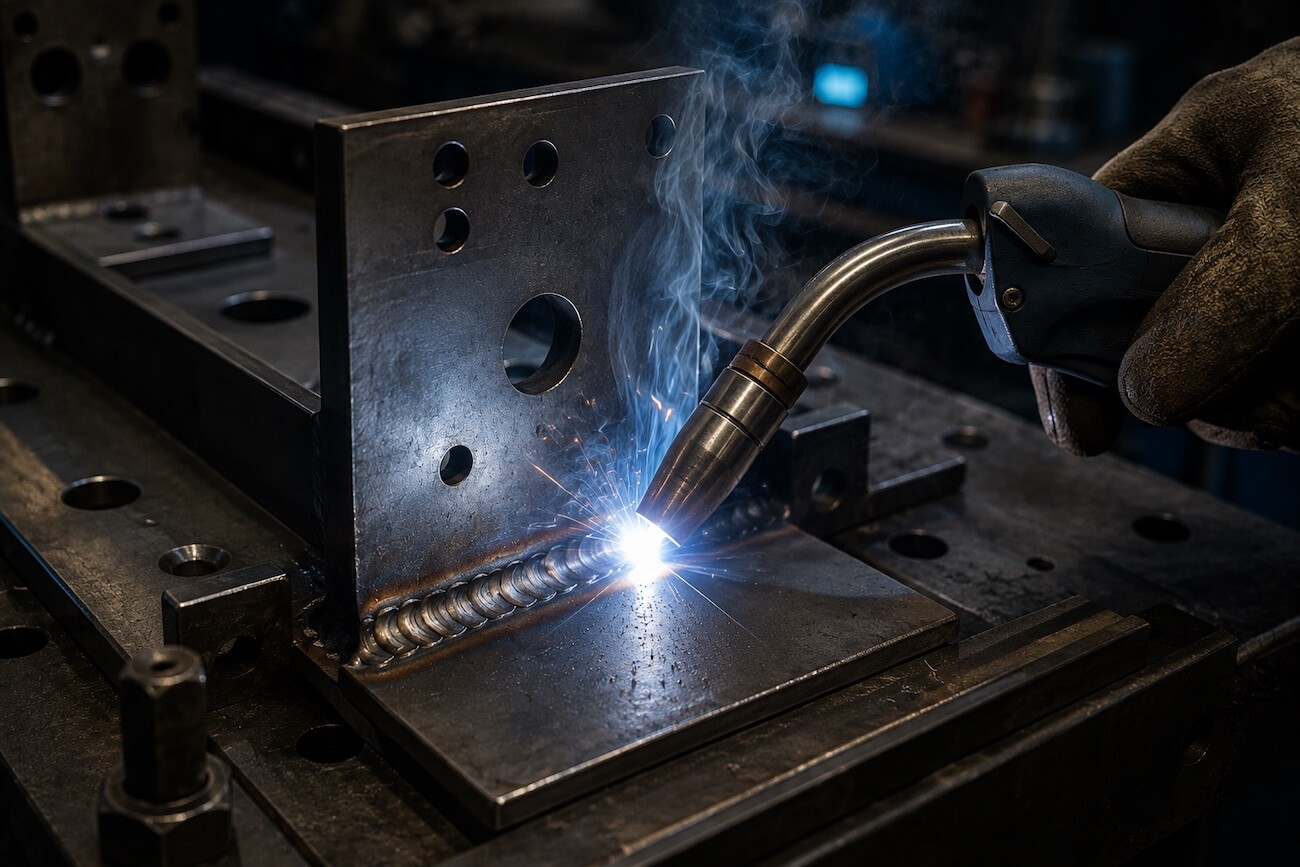
MIG/MAG welding is a method in which a continuously fed wire electrode melts to make the join, while the weld pool is insulated from the air by a shielding gas curtain. It is today the most widely used method for joining general manufacturing steels.
The Difference Between MIG and MAG
Both work on the same principle; the distinction lies in the shielding gas used.
MAG (Metal Active Gas) uses an active gas — carbon dioxide or an argon–carbon dioxide mixture. The gas takes part chemically in the weld pool. It is the standard method for structural steel and general manufacturing steels.
MIG (Metal Inert Gas) uses an inert gas, usually pure argon. The gas does not take part in the pool, it only shields. It is preferred for aluminium and its alloys.
In everyday use both are referred to simply as gas metal arc welding; where manufacturing steel is concerned, what is usually meant is MAG.
Why Is It So Widespread?
It is fast. Because the wire is fed continuously, there is no stopping to change electrodes; long beads are laid without interruption.
It leaves a clean bead. There is no slag to remove as in shielded metal arc welding, which shortens preparation time before delivery.
It is repeatable. Once current, voltage and wire speed are set, consistent results are obtained between parts in serial work.
It is relatively easy to learn and to automate. This makes it suitable for serial manufacturing.
Which Materials Can Be Welded?
MIG/MAG welding is used on mild steel, structural steel and general manufacturing steels. With the appropriate gas and wire selection, stainless steel and aluminium can also be welded; in those materials, however, the method, gas and wire combination changes.
Where Is It Used?
Machine bodies and chassis manufacturing. Load-bearing structures, machine bases and moving assembly bodies are joined by MIG/MAG welding.
Structural work. Platform, stair, handrail and load-bearing profile joints.
Brackets and fasteners. Serially produced mounting brackets, feet and support groups.
Panel and cabinet manufacturing. Corner joints of bent sheet metal bodies.
Custom manufacturing. Individual parts produced from a sample or a technical drawing.
What Determines Weld Quality
Preparation of the joint surface. Rust, oil and paint must be cleaned from the surface before welding; a dirty surface causes porosity.
Part fit. Welding does not correct badly cut or wrongly bent parts. If the gap between them is large, bead quality drops. This is why cutting and bending accuracy is a precondition of weld quality.
Heat input and distortion. Welding heat pulls the sheet; in thin material this distortion is visible to the eye. A sequenced and symmetrical welding plan, tack welding beforehand and the use of a fixture where necessary keep it under control.
Dimensional inspection. In welded manufacturing, the job is right if the part holds its dimensions after welding. This is why intermediate and final inspection against the technical drawing is a separate step.
Standalone Welding or Complete Welded Manufacturing?
If you have had your parts cut and bent, you can take welding as a standalone service; sending them with a technical drawing is enough.
The real benefit, however, appears across the whole chain. When a laser cut part is bent on the press brake and welded in the same facility, parts not fitting each other ceases to be a problem — responsibility for all three steps sits in one place.
Read more about our MIG/MAG welding service and our sheet metal processing workflow.