
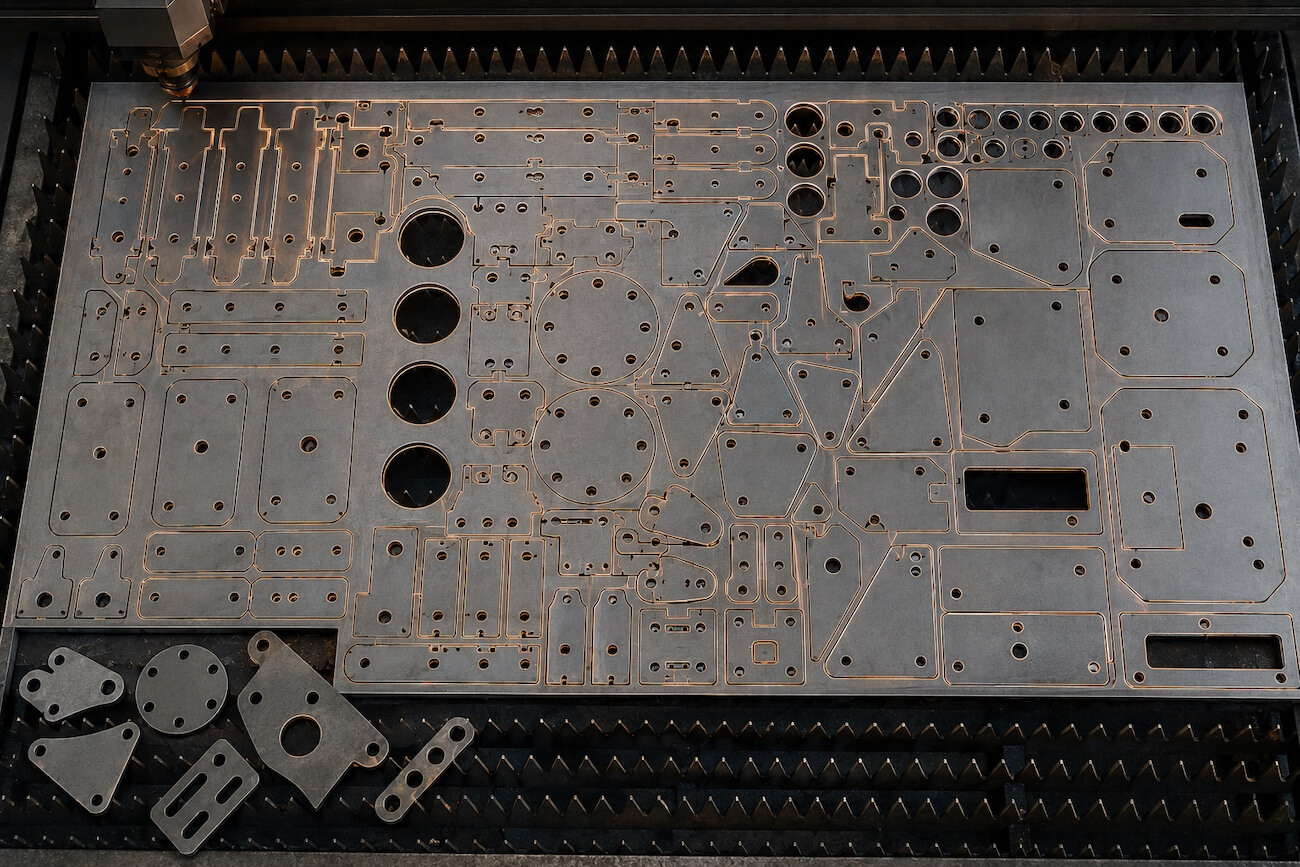
The first question most companies ask when requesting a contract laser cutting quote is the same: "How much per square metre?" There is no single answer, because laser cutting is not priced by area but by the time the machine spends cutting that part. Of two sheets of identical size, one an empty rectangle and the other a panel cover with hundreds of holes, the cost differs enormously.
Below you will find the items that determine the quoted price, the information you need to send when asking for a quote, and practical ways to bring the cost down.
Five Items That Determine the Price
1. Material type and thickness. Mild steel, stainless and aluminium differ both in raw material price and in cutting behaviour. As thickness increases, the head travels more slowly; a laser that covers metres per minute in 2 mm sheet slows noticeably at 15 mm. Stainless and aluminium cut more slowly than mild steel at the same thickness.
2. Cut length and number of holes. The measure that drives cost is not the area of the part but the total length of the cutting contour. Every hole requires a piercing operation; on a part with hundreds of holes, the total piercing time can exceed the contour itself.
3. Quantity. Every job carries a setup cost: checking the file, nesting the parts on the sheet, setting up the machine. That cost is divided across 5 parts or 500. This is why the unit price falls noticeably as quantity rises.
4. Nesting efficiency. The better your parts fit onto a standard sheet size, the less scrap is produced. A single badly fitting dimension can render half a sheet unusable. An experienced supplier spots this at the quotation stage and, where needed, suggests a small change in dimensions.
5. Who supplies the material. If you send the sheet, the quote covers labour only. If we take on supply, the material is added to the quote at market price.
What Should You Send for a Quote?
Three pieces of information are enough for an accurate price: a DXF or DWG file, the material type and thickness, and the quantity. If you have no drawing, a dimensioned PDF technical drawing or a sample part will also do.
If you are wondering how your file should be prepared, take a look at our DXF preparation guide. Most dimensioning errors surface not at the quotation stage but during production, and they cause delays.
Practical Ways to Reduce Cost
Combine your orders. Having different parts of the same material and thickness cut in one go improves nesting efficiency and divides the setup cost.
Choose only the thickness you actually need. Going one grade thicker "to be safe" raises both material and cutting time costs.
Avoid unnecessary holes. Holes added to a design because "they might be useful" become a significant time item in high-volume work.
Have the post-cutting operations done in the same place. If the part will be bent or welded, do not split the process. When cutting happens in one place and bending in another, you pay for transport and waiting, and when dimensions do not match, the argument over responsibility begins.
Do Not Let Price Be the Only Criterion
The lowest quote is the most expensive one if the part does not hold its dimensions or is not delivered on time. When choosing a supplier, also ask what the cutting tolerance is, whether first part approval is given, and whether bending and welding are done after cutting.
At Depota Raf we provide fiber laser cutting on sheet metal, pipe and profile; bending and welding after cutting run in the same facility. We describe the whole process on our sheet metal processing services page.
Send us your drawing and quantity, and we will prepare a quote covering material, labour and lead time.